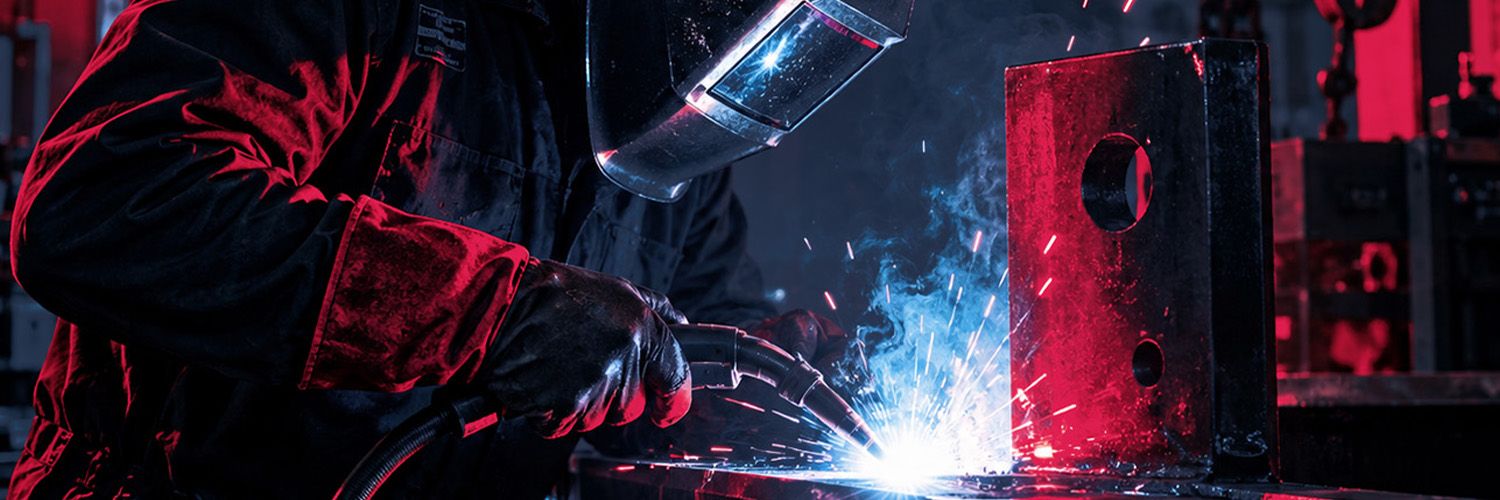
In practice, choosing the right welding technique depends on three factors: the base material (steel, stainless steel, or aluminium), material thickness, and the working environment (indoors in a workshop or outdoors on-site). For structural work and high production speeds indoors, you typically use MIG/MAG. If you are looking for maximum aesthetic finish and control on thin-walled stainless steel or aluminium, TIG is the preferred method. If you need to weld steel profiles outdoors in varying weather conditions or perform repairs on dirty or slightly rusted metal, MMA (stick welding) offers the greatest reliability.
The matrix below provides direct insight into the characteristics and usability of common arc welding processes.
| Welding technique | ISO 4063 process | Weld pool shielding | Suitable for | Typical material thickness | Working environment | Difficulty level |
|---|---|---|---|---|---|---|
| MIG | 131 (GMAW) | Inert gas (pure argon or helium) | Aluminium, copper alloys | 1.0 – 12+ mm | Indoors / draft-free | Intermediate |
| MAG | 135 / 136 (GMAW / FCAW) | Active gas (argon/CO₂ or 100% CO₂) | Structural steel, boiler steel | 0.8 – 15+ mm | Indoors / draft-free | Low to intermediate |
| TIG | 141 (GTAW) | Inert gas (100% argon) | Stainless steel, aluminium, thin-walled steel | 0.5 – 6 mm | Indoors / draft-free | High (two-handed) |
| MMA (stick) | 111 (SMAW) | Slag-forming flux coating (rutile, basic) | Unalloyed steel, cast iron, stainless steel | From approx. 2.0 mm | Indoors and outdoors (wind-resistant) | Intermediate |
The Four Primary Welding Techniques at a Glance
In industrial practice, we distinguish four widely used fusion welding processes:
- MIG/MAG welding (process 131/135): A consumable wire electrode is continuously fed through a torch. An external shielding gas protects the molten weld pool against atmospheric oxygen and nitrogen.
- TIG welding (process 141): A non-consumable tungsten electrode strikes the electric arc. Filler material is manually fed into the weld pool with the other hand under a blanket of inert argon gas.
- MMA stick welding (process 111): A consumable metal core wire covered with a flux coating generates both a protective shielding gas and a molten slag layer over the weld seam as it melts.
- Submerged arc welding (SAW, process 121) or Oxy-fuel welding (process 311): In heavy industrial shipbuilding and pressure vessel fabrication, submerged arc welding is used, where the arc burns beneath a granular flux layer for very high deposition rates. In installation and maintenance work, oxy-fuel welding using an oxygen-acetylene flame is still occasionally used, mainly for preheating, flame cutting, or welding thin pipes.
When purchasing suitable welding machines, the duty cycle is the leading specification. A duty cycle of 200 A at 60% (at 40 °C according to EN 60974-1) means that within a 10-minute cycle, you can weld continuously at 200 amps for 6 minutes before thermal overload protection kicks in.
The Difference Between MIG and MAG Welding
The difference between the two methods does not lie in the mechanics of the welding machine or the torch type, but purely in the shielding gas used and the metallurgical reaction in the weld pool:
- MIG stands for Metal Inert Gas: The shielding gas does not react chemically with the molten weld pool. Pure argon (Argon 4.6 or 5.0) or argon mixed with helium is used for this purpose. MIG welding is applied to non-ferrous metals such as aluminium, aluminium-magnesium alloys, and copper. Using an active gas on aluminium would immediately result in severe oxidation and porous joints.
- MAG stands for Metal Active Gas: The shielding gas actively reacts within the welding process to optimize penetration, arc stability, and bead wetting. The industrial standard for unalloyed structural steel is a gas mixture of approximately 82% to 85% argon supplemented with 15% to 18% carbon dioxide (CO₂). The CO₂ content provides wider penetration and reduces undercut. For thin sheet metal in auto body repair, mixtures with less CO₂ (such as 90/10) are sometimes used, or pure CO₂ in heavy structural work where spatter is less of an issue.
For welding stainless steel using the continuous wire process, an intermediate variant is typically used: an inert argon gas with 2% CO₂ or O₂ added to stabilize the arc without compromising the corrosion resistance of the stainless steel.
MMA Stick Welding: The Reliable Choice for Outdoor Installation
MMA stands for Manual Metal Arc (designated as process 111 under EN ISO 4063, referred to as SMAW in the American AWS standard). In the Benelux, this technique was traditionally known for decades by the abbreviation BMBE (Booglassen met Beklede Elektrode). In modern specifications and with contemporary inverter power sources, the industry almost exclusively uses the term MMA.
The major advantage of MMA stick welding is complete independence from external gas cylinders. The flux coating surrounding the metal core wire burns in the arc and forms a local shielding gas. Simultaneously, the coating melts to form a floating slag layer over the weld pool. This makes MMA a dependable solution for assembly work on outdoor jobsites:
- Wind-resistant: Where drafts or wind quickly blow away the shielding gas in MIG/MAG or TIG (leading to porosity), the weld pool in MMA remains protected by the dense slag and localized gas development.
- Tolerance for surface contamination: MMA generally burns through light rust, mill scale, or a thin coat of paint more effectively than gas-shielded processes.
- Flexibility: With a compact welding inverter and a tube of welding electrodes, you can easily work on scaffolding or locations where gas cylinders are difficult to handle.
In MMA welding, you choose the coating type based on mechanical requirements and welding position:
- Rutile coating (class R): Highly stable arc, easy restriking, smooth bead profile, and the slag detaches easily. Suitable for general fabrication and tack welding.
- Basic coating (class B): Offers high toughness values at low temperatures and superior resistance to cold cracking. Requires a direct current power source (DCEP / electrode holder on the positive terminal) and must be stored dry (preferably in an electrode drying oven) to prevent hydrogen absorption.
After each weld pass with MMA, you must completely chip away the solidified slag layer using a chipping hammer and clean the bead with a wire brush before applying the next pass. Leaving slag remnants behind causes slag inclusions, which severely weaken the joint internally.
TIG Welding for Stainless Steel and Aluminium: Precision and Control
TIG stands for Tungsten Inert Gas (process 141). Because the tungsten electrode itself does not melt, the arc serves solely as a concentrated heat source. This allows you to regulate heat input and filler metal addition entirely independently of each other.
For workpieces made of stainless steel and aluminium, TIG is considered the benchmark for precision work:
Welding Stainless Steel with TIG (DC - Direct Current)
Stainless steel is TIG welded on direct current, with the torch connected to the negative terminal (DCEN - Direct Current Electrode Negative). This concentrates approximately 70% of the heat in the workpiece, leaving the tip of the tungsten electrode intact.
- When welding thin-walled stainless steel pipes, always use a purging gas (such as nitrogen or argon) inside the pipe. Without root shielding gas, the backside of the joint burns due to reaction with atmospheric oxygen, leading to “sugaring” (chromium burn-off), which causes the stainless steel to lose its corrosion-resistant properties locally.
Welding Aluminium with TIG (AC - Alternating Current)
Aluminium has a natural oxide layer (aluminium oxide, Al₂O₃) that melts at approximately 2,050 °C, whereas the underlying aluminium liquefies at around 660 °C. If you were to weld aluminium on DC negative, the base metal would melt away internally before the oxide layer broke open.
- Therefore, aluminium requires TIG welding with alternating current (AC).
- During the positive half-cycle, electrons are emitted from the base material; this mechanically breaks open the tough oxide layer (cleaning action).
- During the negative half-cycle, current flows toward the workpiece, providing the necessary penetration.
The Difference Between MIG/MAG and TIG Welding
Although both MIG/MAG and TIG utilize an electric arc and shielding gas, they differ dramatically in working speed, handling, and application scope:
- Torch handling and operation: In MIG/MAG, you operate the welding gun with one hand. As soon as you pull the trigger, the gas flow starts, the arc strikes, and the wire feeder continuously feeds the wire into the weld pool. In TIG, you manipulate the torch with one hand at a steady arc length of approximately 2 millimetres, while manually feeding filler rods into the weld pool with the other hand.
- Production speed versus aesthetics: MIG/MAG provides a significantly higher deposition rate (kilograms of deposited metal per hour). This makes it economically attractive for structural steelwork. TIG is slower, but produces a finely rippled seam profile with minimal spatter. Post-weld cleanup (such as grinding or sanding) is virtually unnecessary with TIG.
- Heat control: TIG provides superior control over the weld pool on thin sheet thicknesses (below 1.5 mm). With MIG/MAG on thin sheet, you run a higher risk of burn-through unless you use a pulsed power source.
Which Welding Technique Is the Easiest to Learn?
For a beginner or DIYer, MAG welding is generally the easiest technique to master.
Because the filler wire is fed automatically at a constant speed through the hose package, you mainly need to focus on three things:
- The correct torch angle (approximately 10 to 15 degrees pushing or dragging).
- A consistent stick-out (wire extension of roughly 10 to 12 mm between the contact tip and the workpiece).
- A steady travel speed.
MMA welding requires more practice in striking the electrode (without sticking) and demands continuous manual compensation as the covered electrode burns down. TIG requires by far the most hand-eye coordination and filler wire control; briefly dipping the tungsten tip into the weld pool immediately contaminates the electrode, which must then be re-ground.
The Fundamental Difference Between Welding and Soldering/Brazing
Contrary to popular belief, soldering or brazing is not merely a lighter form of welding. The difference between welding and soldering/brazing is metallurgical in nature:
- Welding: The base material of the two parts to be joined is melted at the edges by the heat of an arc or flame. The filler metal melts alongside at the same temperature. Upon solidification, the workpieces and the filler metal form a single metallurgical unit. The strength of a properly executed weld joint equals that of the base material.
- Soldering / Brazing: The base material is not melted. Only a filler metal (solder or braze alloy) with a significantly lower melting point than the base material is used (soft soldering < 450 °C; hard soldering / brazing > 450 °C). The bond is formed through adhesion and capillary action between the molten filler metal and the heated, solid surface of the workpiece.
Common Mistakes in Practice and How to Prevent Them
During welding, defects are rarely caused by the power source, but almost always by incorrect settings or inadequate preparation:
1. Porosity from Drafts or Contamination
Porosity appears as small gas bubbles or craters in the weld bead. This occurs when shielding gas is blown away (by open doors or fans) or when grease, moisture, oil, or zinc on the metal surface decomposes in the welding arc.
- Solution: Thoroughly clean the material down to bare metal beforehand using angle grinders fitted with a grinding or flap disc. Shield the indoor work area properly from drafts.
2. Lack of Fusion from Incorrect Torch Angle or Low Arc Voltage
Lack of fusion means that the weld metal sits on top of the base material without properly fusing into it. This frequently occurs in MAG welding when the welder moves forward too fast or points the arc at the already liquid weld pool rather than directly at the joint root.
- Solution: Maintain a stable arc length and always aim the arc at the leading edge of the weld pool and the cold base material.
3. Slag Inclusions in MMA Welding
When slag runs ahead of the weld pool during welding, molten metal flows over the slag. This traps non-metallic cavities inside the joint.
- Solution: Apply the correct drag angle (approximately 15 degrees tilted away from the direction of travel) and ensure your travel speed is high enough to keep the weld pool ahead of the slag.
Do not weld directly on galvanized steel without first mechanically grinding away the zinc coating for at least 25 mm around the weld zone. Burning zinc releases heavy, toxic zinc oxide fumes that can cause zinc chills (metal fume fever).
Safety and Protection During Welding
Temperatures in the welding arc exceed 5,000 °C. This process generates intense ultraviolet (UV) and infrared (IR) radiation, sparks, and hazardous welding fumes:
- Eye and face protection: Always use approved auto-darkening welding helmets compliant with EN 379. Ensure the correct shade level (DIN shade) is selected: DIN 9 to 11 for MAG/MMA up to roughly 150 amps, and DIN 11 to 13 for heavier welding above 200 amps. For TIG welding at low amperages (under 100 A), a lighter shade is preferred (DIN 8 to 10), in accordance with EN 169.
- Skin protection: Wear flame-retardant welding apparel made of heavy split cowhide or specially treated cotton (EN ISO 11611). Regular synthetic clothing can melt instantly upon contact with welding spatter.
- Fume extraction: Ensure effective local source extraction. Particularly when welding stainless steel (which releases carcinogenic hexavalent chromium), targeted extraction or a full-face respirator with a powered air-purifying respirator system (PAPR with TH3-class particulate filter in accordance with EN 12941) is mandatory.
Frequently Asked Questions About Welding Techniques
Which gas cylinder do I need for all-round welding?
There is no universal shielding gas for all processes. For steel with MAG, use a mixed gas of 82% to 85% argon with 15% to 18% CO₂. For aluminium (MIG or TIG) and stainless steel (TIG), you need pure argon (minimum purity 4.6). If you want to work without gas cylinders, choose MMA stick welding or use self-shielded flux-cored wire (FCAW-S).
Can I weld aluminium with a standard stick welder (MMA)?
Special aluminium welding electrodes exist for MMA, but in practice, this is only suitable for emergency repairs on thick cast parts. Because aluminium dissipates heat very quickly and the electrode coating is highly hygroscopic, MMA on aluminium produces a porous weld with excessive spatter. For high-quality structural work on aluminium, AC TIG or pulsed MIG is the recommended method.
What do DCEP and DCEN mean on my welding machine?
These terms indicate the polarity of the welding circuit. DCEP (Direct Current Electrode Positive) means the electrode holder or wire torch is connected to the positive terminal. This provides deeper penetration in MAG welding and is standard for basic electrodes (for deep penetration and ductile joints), whereas rutile electrodes on DC are typically welded on the negative terminal (DCEN) or on alternating current (AC). DCEN (Direct Current Electrode Negative) means the torch is connected to the negative terminal; this is used in TIG welding of steel and stainless steel (to avoid overheating the tungsten electrode) and with certain types of gasless flux-cored wires.
Why does my stick electrode keep sticking when striking an arc?
Sticking is generally caused by an ignition amperage that is too low, insufficient arc voltage, or an incorrect striking angle. Preferably use a welding machine with built-in Hot Start (delivers a temporary current surge upon ignition) and Anti-Stick (instantly cuts off the current once the electrode sticks, preventing it from overheating). Strike the electrode like striking a match rather than pressing straight down onto the workpiece.