Choosing and using a grease gun: manual, pneumatic, or cordless
Choosing a suitable grease gun mainly depends on the number of lubrication points per week, the required mobility, and control over delivery pressure. For occasional maintenance of up to approximately fifteen lubrication points per week, a manual grease gun is sufficient; it provides direct tactile feedback to prevent overloading bearing seals. If you have a permanent maintenance workshop with a compressed air network and lubricate heavy components directly from drums, a pneumatic grease pump works fastest. If, on the other hand, you need to grease dozens to hundreds of nipples weekly across various locations—such as on agricultural, earthmoving, or transport equipment—a cordless grease gun saves a considerable amount of time and physical effort.
Selecting the drive system is only half the battle. Without understanding the pressure build-up, powered pumps can easily blow out oil seals, air pockets cause inconsistent delivery, and stiff grease at low temperatures can block the dispensing system. In this article, you will learn which system suits your machinery fleet and how to prevent common lubrication mistakes in practice.
Comparing the three drive systems
Each drive type requires a balance between leverage, dosing accuracy, and freedom of movement.
Manual grease gun: lever versus pistol-grip model
The manual grease gun remains the industry standard for targeted precision work. Within this category, you can choose between two basic designs:
- Lever-action grease gun: Operated with two hands using a long lever. This makes it relatively easy to build pressure up to approximately 400 bar, which is useful for forcing thick, dried-out grease through a clogged grease fitting. The disadvantage is that you do not have a free hand to hold the coupler on the nipple when positioned at an awkward angle.
- Pistol-grip grease gun: This model operates with a pistol grip. The delivery per stroke is lower and the maximum pressure is typically limited to 250 to 300 bar, but you keep one hand free to guide the flexible hose onto hard-to-reach grease nipples.
The decisive advantage of both manual models is tactile feedback: as soon as a bearing cavity fills up or a nipple blocks, you immediately feel a distinct increase in backpressure on the lever.
Pneumatic grease pump: continuous flow in the workshop
A pneumatically driven pump uses compressed air from the workshop via a piston mechanism. These pumps operate with a fixed pressure ratio (often 40:1 to 50:1). With a standard inlet pressure of 6 to 8 bar, the pump delivers a working pressure of 300 to over 400 bar.
Pneumatic systems are available as handy cartridge air guns, but are more commonly mounted on mobile drum trolleys (for 18 to 50 kg grease drums). The system features virtually no wear-sensitive electronics or batteries that can drain. The limitation lies in the working radius: due to the reliance on a compressor and air hoses, this system is less suitable for mobile field repairs. Furthermore, there is no physical feel for backpressure.
Cordless grease gun: maximum output and freedom of movement
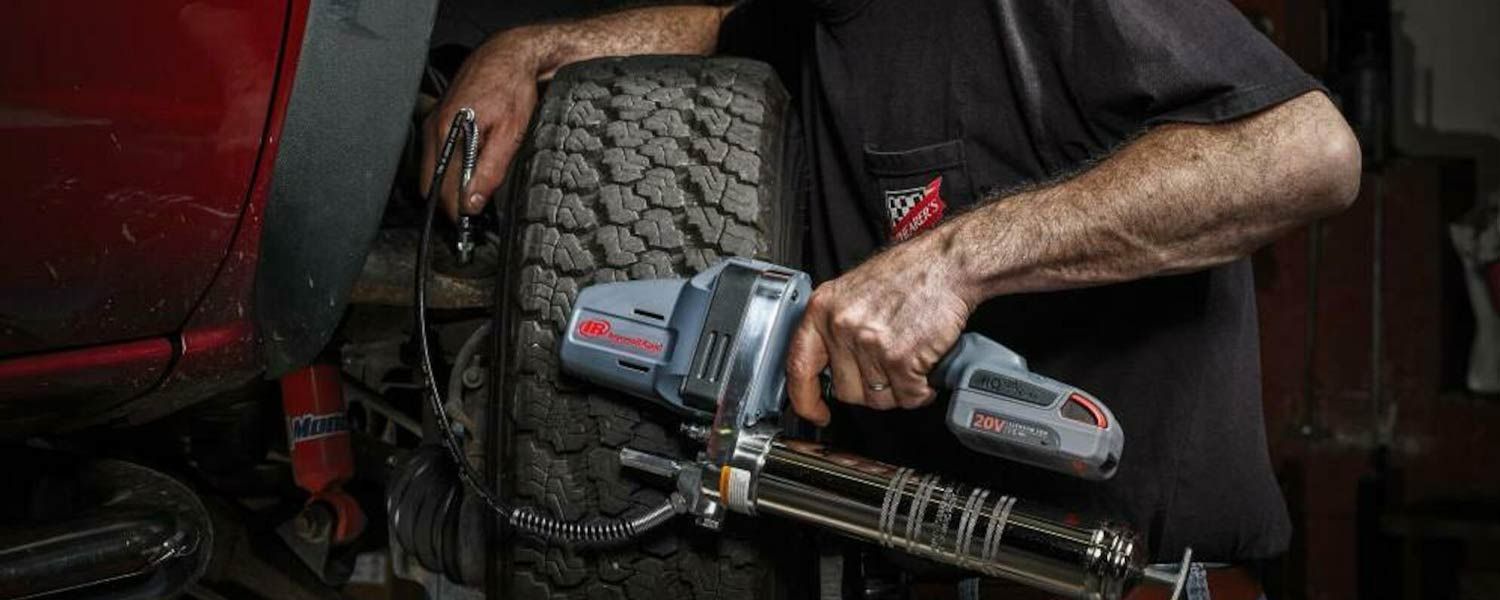
For professionals in agriculture, contracting, and forestry, an 18V or 20V cordless grease gun is an ergonomic option. Modern models deliver a maximum working pressure of 500 to nearly 700 bar (approx. 10,000 PSI) and pump grease at a continuous flow rate of up to dozens of grams per minute.
For instance, a professional 18V cordless grease gun typically provides sufficient discharge pressure to clear heavy lubrication channels and processes multiple grease cartridges on a single battery charge.
The major benefit is working speed: excavators, dumpers, or harvesters with dozens of pivot points can be lubricated quickly without heavy physical strain on arms and wrists. The downside is the weight (often 3.5 to 4.5 kg including battery and full cartridge) and the higher purchase price.
Technical specifications side by side
The table below outlines the technical differences and operational limits of the three systems:
| Feature | Manual grease gun (lever model) | Pneumatic grease pump | Cordless grease gun (18V) |
|---|---|---|---|
| Typical working pressure | 300 – 400 bar | 300 – 450 bar | 450 – 690 bar |
| Dispensing speed | Manual (~1 to 1.5 g/stroke) | Continuous high flow via trigger | High and adjustable (~70 to 200 g/min) |
| Tactile feedback | Directly felt on lever | None (fully mechanical) | None (risk of overpressure) |
| Mobility | Fully autonomous, compact | Tethered to air hose | Fully autonomous, heavier in hand |
| Suitable application | < 15 grease points per week, precision greasing | Garage workshop, drum setup | > 25 grease points per week, mobile equipment |
Pressure and dosing: the risk of damaged oil seals
A persistent misconception is that higher pressure is always better. The high maximum output pressure of a grease gun (often 400 to 690 bar) is intended solely to clear clogged lines, fouled grease passages, and stuck ball checks in grease nipples. Once the grease enters the bearing housing, the built-up pressure must not rise uncontrollably.
Standard radial shaft seals and rubber oil seals (lip seals) can generally fail under an internal pressure as low as 1 to 3 bar. When pulling and holding the trigger on a sealed bearing using a pneumatic grease pump or powerful cordless grease gun, you can quickly blow the seal out or tear the rubber sealing lip. As a result, grease leaks out, lubrication fails, and moisture and dirt penetrate the bearing housing.
Preferably use powered grease guns with controlled pulses on bearings with closed seals. Stop greasing as soon as you hear resistance in the motor RPM, or consult the equipment manufacturer’s lubrication schedule for the exact amount of lubricant per service interval.
Additionally, overfilling high-speed bearings leads to overheating. The rolling elements encounter excessive friction resistance in the surplus grease, leading to grease degradation (channeling and base oil bleed) and premature bearing failure.
Cartridge systems: DIN 1284, Lube-Shuttle, or bulk grease
The barrel design of a grease gun determines how you load the lubricant. The three common methods each have pros and cons regarding cleanliness and risk of malfunctions.
Standard DIN 1284 cartridges
The universal grease cartridge according to DIN 1284 contains 400 grams of grease, has a diameter of 53.5 mm, and a length of 235 mm.
You pull off the pull-tab base, insert the cartridge into the barrel, and release the follower rod with compression spring to press the grease forward.
- Advantage: Widely available and economical to purchase.
- Disadvantage: Prone to air pockets during loading; residual grease often remains in the barrel upon removal, easily creating a mess.
Lube-Shuttle screw-in cartridges
The Lube-Shuttle system works with threaded cartridges made of rigid plastic. Instead of a heavy spring and follower rod, the grease gun pulls the grease under vacuum from the cartridge via a plastic follower piston.
- Advantage: Virtually complete emptying of the cartridge without wasting grease. Clean cartridge changes via the thread without needing to dismantle the barrel.
- Disadvantage: Cartridges are more expensive than DIN 1284, and the gun must be specifically equipped with a compatible screw-in head (or adapter).
Refilling with bulk grease
For heavy workshop use, refilling from a grease drum (18 to 50 kg) using a filler pump or bulk loader fitting is financially the most attractive. However, this demands care: open grease containers attract dust and dirt. A single grain of sand in the pump head can foul the grease gun’s internal check valve.
Eliminating air pockets: step-by-step bleeding guide
The most common problem with grease guns is air lock. If the plunger draws in air instead of grease, the pump cannot build pressure and the coupler remains dry. This step-by-step guide resolves the issue with standard cartridges.
1. Slightly unscrew the barrel
Unscrew the barrel containing the cartridge one and a half to two turns from the pump head. This allows trapped air between the cartridge and the inlet to escape through the threads.
2. Release and push the follower rod
Pull the metal rod at the rear of the grease gun all the way back and disengage it from the locking slot. Now firmly push the rod forward by hand while slowly retightening the barrel onto the pump head threads.
3. Activate the air bleed valve
Does your grease gun feature a manual air bleed valve (a push button on the head)? Press it repeatedly while applying forward pressure to the follower rod. You will hear a hissing sound as the compressed air pocket escapes and grease begins oozing past the valve.
4. Pump with short strokes
If the pump does not have a bleed valve, pump with short, rapid lever or trigger strokes until the plunger primes and grips the grease. As soon as a steady stream of grease without air bubbles emerges from the coupler, the system is bled and ready for use.
Couplers and grease viscosity: NLGI 2 in practice
Even a powerful grease pump will underperform if the coupler leaks or the grease is not matched to the conditions.
Choosing the grease coupler
The standard coupler with four hardened jaws slips over a hydraulic grease nipple (type H according to DIN 71412). When slightly misaligned or worn, grease will squirt out past the nipple instead of entering it.
In professional applications, quick-release locking couplers with a lever mechanism prove their worth. These lock mechanically onto the nipple head. They stay leak-free under high pressure and disconnect easily via the thumb lever without having to yank on the hose.
The impact of cold on NLGI 2 grease
By far most universal machinery grease falls under NLGI 2 grease (a consistency grade comparable to peanut butter). At normal ambient temperatures (15 to 25 °C), this grease flows evenly toward the inlet port.
At outdoor temperatures near or below freezing, the base oil viscosity increases sharply. The grease becomes stiff and tacky. Powered and pneumatic pumps will then easily draw voids (air pockets caused by cavitation) into the grease around the suction port. Therefore, store grease cartridges and the grease gun in a frost-free workshop or cab during winter to prevent pump blockages.
Do you need to lubricate regularly at sub-zero temperatures? Consult the equipment manufacturer about using a lighter NLGI 1 or semi-fluid NLGI 0 grease for central or mechanical systems.
Common mistakes in machine and manual greasing
- Failing to clean the grease fitting before connecting. Dust, sand, and road grime accumulate around the ball check of the grease fitting. Snapping the coupler directly onto this forces abrasive contaminants straight into the bearing. Always wipe each fitting clean with a cloth beforehand.
- Yanking the hose off the fitting under residual pressure. When a fitting blocks, high pressure remains trapped in the grease hose. Pulling the coupler off at an angle under force can damage both the nipple and the coupler jaws. For stuck standard couplers, unscrew the coupler barrel half a turn to relieve the pressure, or use a quick-release coupler with a disengage lever.
- Mixing incompatible grease types. Greases with different thickener bases (such as lithium complex, calcium sulfonate, or polyurea) are chemically incompatible. Mixing them can cause the soap matrix to break down: the grease either hardens or loses its consistency entirely and leaks out of the bearing housing. Always use the specified lubricant type.
- Blowing out oil seals by pumping too fast. Treat rotating components with rubber seals gently. If you feel sudden resistance with a manual gun, stop immediately. With a cordless grease gun, pump at low speed and visually verify that old grease flows smoothly out of the purge ports.
Frequently asked questions about grease guns and pumps
How many grams of grease does one stroke of a manual grease gun deliver?
An average manual lever grease gun delivers approximately 1.0 to 1.5 grams of grease per full stroke. A pistol-grip gun typically delivers slightly less: around 0.6 to 0.8 grams per stroke. Industrial bearing manufacturers often specify lubrication requirements in grams in maintenance schedules; when in doubt, weigh ten strokes on a precision scale to verify the exact output of your gun.
What working pressure does a grease gun deliver and how much pressure is actually needed?
Most grease guns reach a maximum pressure between 300 and 690 bar. Forcing grease into an open, well-maintained bearing rarely requires more than 10 to 20 bar. The high maximum pressure serves solely to dislodge hardened old grease or stuck ball checks in clogged grease fittings.
Why won’t my grease gun build pressure after changing a cartridge?
This is usually caused by trapped air between the pump plunger and the cartridge. Loosen the barrel half a turn, push the follower rod at the rear firmly forward, and depress the air bleed valve to let the trapped air pocket escape.
Can I use any standard 400-gram cartridge in a Lube-Shuttle grease gun?
No. Standard DIN 1284 cartridges have an open pull-off bottom and operate with an internal follower spring. The Lube-Shuttle system requires special threaded plastic cartridges with an integrated follower piston. However, adapters exist to fit certain alternative cartridges, provided the gun’s design permits it.