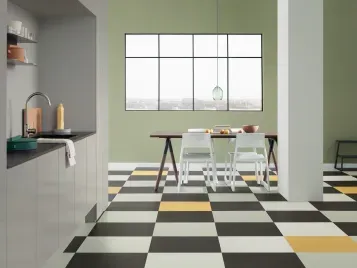
Linoleum is no longer the dull sheeting of the past. The wide range of available colours and patterns makes a linoleum floor suitable for every living taste. An additional advantage of linoleum is its eco-friendliness. Unlike vinyl, for example, linoleum is made from natural resources. Thanks to the convenient click system, you can easily lay a linoleum floor yourself.
Linoleum or Marmoleum?
The name linoleum derives from the Latin words linum (flax) and oleum (oil), with linseed oil from flax being a key ingredient. Other components of linoleum include wood flour, pine resin, ground cork dust, and mineral fillers. The terms linoleum and marmoleum are often used interchangeably. However, there is no difference. Marmoleum is the brand name given to its linoleum floors by the Dutch manufacturer Forbo. Since Forbo is the leading producer worldwide in this field, this brand name has become a generic term.
Laying a Linoleum Floor: The Subfloor
You can lay linoleum on almost any subfloor, provided it is completely flat. If the subfloor shows variations of more than 2 millimetres, it must first be levelled which can be done in various ways. For a wooden subfloor, MDF boards are suitable. A concrete subfloor is usually levelled with a liquid levelling compound.
Laying a Linoleum Click Floor Yourself
Traditionally, linoleum was glued to the subfloor in strips, after which the seams were welded shut. This is still a favourite method for larger projects, but for DIYers, laying a floating floor with the click system is a much simpler solution.
Such a system consists of linoleum panels on an HDF carrier and cork. The carrier is milled with tongue and groove so the panels are easily interconnected. You can easily create a sleek floor to your own design with elongated panels and tiles and a choice of different combination tones. Matching skirting boards complete the look.
Make a laying plan and decide where to start. Long panels are best placed in the direction of the longest wall for an optimal visual effect. Start with the first row. Place the first panel or tile in the corner of the room, and remove the click profile on both the long and short sides. Click the next panel into the first and continue in this manner. Use a rubber mallet to gently tap the connection closed.
Watch this video for inspiration!
Not Suitable for Damp Areas
As beautiful, durable, and maintenance-friendly as a linoleum floor is, the material does not tolerate water well. Since the click system never achieves a completely sealed surface, this type of floor is unsuitable for bathrooms, kitchens, toilets, or other damp areas.
For more advice on flooring, also read Laying your own parquet.