Measuring a right angle
The preferred tool for marking a 90% angle on a work piece is the carpenters’ square. You can assume that your square is indeed square, but to be on the safe side you can check this by holding it against the work piece from both sides and marking the cutting line twice. If the pencil lines exactly overlap, you’re reassured.
Tip: If you do not have a square in your tool box, a hand saw can offer a solution. The angle between the handle and the top of the saw blade is usually square. Press the handle against the work piece and mark the cutting line along the saw blade.
Measuring large right angles
If you want to set a large right angle – for example if you are going to tile a floor – then a 3-4-5 hook is useful. You can make this simple tool yourself by screwing together three slats – which measure in length as 3: 4: 5 – in the shape of a triangle. With a hook of, for example, 75 by 100 by 125 centimeters, you are equipped for a big job.
Measuring angles with a swivel hook
A swivel hook consists of two parts that can move relative to each other. Loosen the screw and you can measure any angle with it. By then tightening the screw the angle is fixed and can be marked. In this video you can see how a swivel hook is used when installing a skirting board.
Measuring angles with a digital protractor
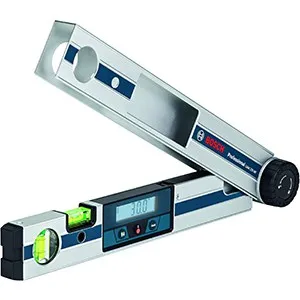
The ultimate in precision and ease of use are battery powered digital protractors. These instruments measure all possible angles with an accuracy of approx. 0.1%. The angle can be read on a display and the data can be saved and transferred at the touch of a button. You can find these professional angle meters at Klium from brands such as Facom and Bosch. They are available in different versions, including combined with a spirit level.